How can a therapy practice cut no-shows fairly?
A therapy practice cuts no-shows fairly by removing the friction that causes them rather than charging clients for the result. That means confirmed bookings, spaced reminders that each carry a one-tap reschedule link, a way for clients to cancel outside business hours without a phone call, and a waitlist that fills the gap when they do.
The fairness question matters because counselling clients are not a general clinic population. A client who misses a session because their anxiety spiked that morning is not behaving carelessly. They are behaving consistently with what brought them in. A policy that treats the two identically is not a deterrent. It is a penalty on symptom presentation.
Here is the shape of a policy that holds the schedule without punishing the client:
Why do punitive cancellation policies fail in counselling?
Punitive cancellation policies fail in counselling because they add a financial consequence to an avoidance behaviour that the client is already in treatment for. The client who cannot face the session also cannot face the phone call to cancel it, and adding a fee to that phone call makes the call harder, not easier. The practice then loses the appointment, the fee conversation, and often the client.
Three secondary problems follow:
- Collection is uncomfortable and often unsuccessful. Chasing a fee from a distressed client puts the administrator, and sometimes the clinician, in an adversarial role with someone they are meant to be supporting.
- The policy punishes the wrong people. Clients with unstable work schedules, caregiving duties, or transport barriers miss sessions more often. A flat fee lands hardest on the clients with the least room to absorb it.
- It does not fill the hour. A fee recovers some revenue. It does not put a person in the chair, and it does not shorten the waitlist behind them.
A fee is a billing mechanism. The no-show is an operations problem, and operations problems respond to operations fixes.
What actually causes counselling no-shows?
Counselling no-shows cluster around four causes, and three of them are front-office issues rather than client-motivation issues.
- Forgetting. The appointment was booked weeks ago, nothing confirmed it since, and it never made it onto the client's calendar.
- Unreachability. The client tried to reschedule, reached voicemail, and gave up. This is the quietest cause and the most expensive one, because the client wanted to keep the appointment.
- Avoidance. The session sits close to difficult material and the client cannot face it that morning. Cancelling requires a conversation they also cannot face.
- Circumstance. Childcare fell through, the bus did not come, the shift changed.
Only avoidance is clinical. The other three are logistics, and logistics are solvable without a policy change at all. If your practice has not measured how many reschedule attempts never reach a human, that number is usually the fastest win available. The same pattern shows up across clinic types, and what missed calls actually cost a clinic is usually larger than the no-show line item it feeds.
What does a fair counselling no-show policy look like in writing?
A fair counselling no-show policy states the notice window, the consequence, and the exit path in plain language, and the exit path appears everywhere the policy does. Clients should never have to search for how to move an appointment.
A workable structure:
Notice window. Ask for 24 hours. State it once at intake, then repeat it in each reminder message rather than burying it in a signed form.
First missed session. No charge. An automatic message goes out the same day offering to rebook, worded without reproach. Something close to: "We missed you today. Here are your therapist's next open times if you'd like to pick one up."
Pattern of missed sessions. The clinician raises it in session as clinical material, because in therapy it usually is. An administrator raising it as a billing matter first will damage the alliance.
Late cancellation fee, if you keep one. Apply it only after a documented pattern and a conversation, never automatically on a first instance, and state any exceptions (illness, crisis, safety) in the written policy so clients do not have to ask.
Reschedule access. Available 24 hours a day by text or link. This is the part most policies omit, and it is the part that changes behaviour.
Provincial privacy rules apply to every one of these messages. Reminder and follow-up texts in Canadian practices fall under PIPEDA or the applicable provincial statute, such as PHIPA in Ontario, PIPA in British Columbia and Alberta, or Alberta's HIA for custodians, and consent for electronic messages is governed by CASL. Keep clinical detail out of the message. Name, date, time, and a reschedule link are enough.
How do reminders and automation reduce no-shows without penalties?
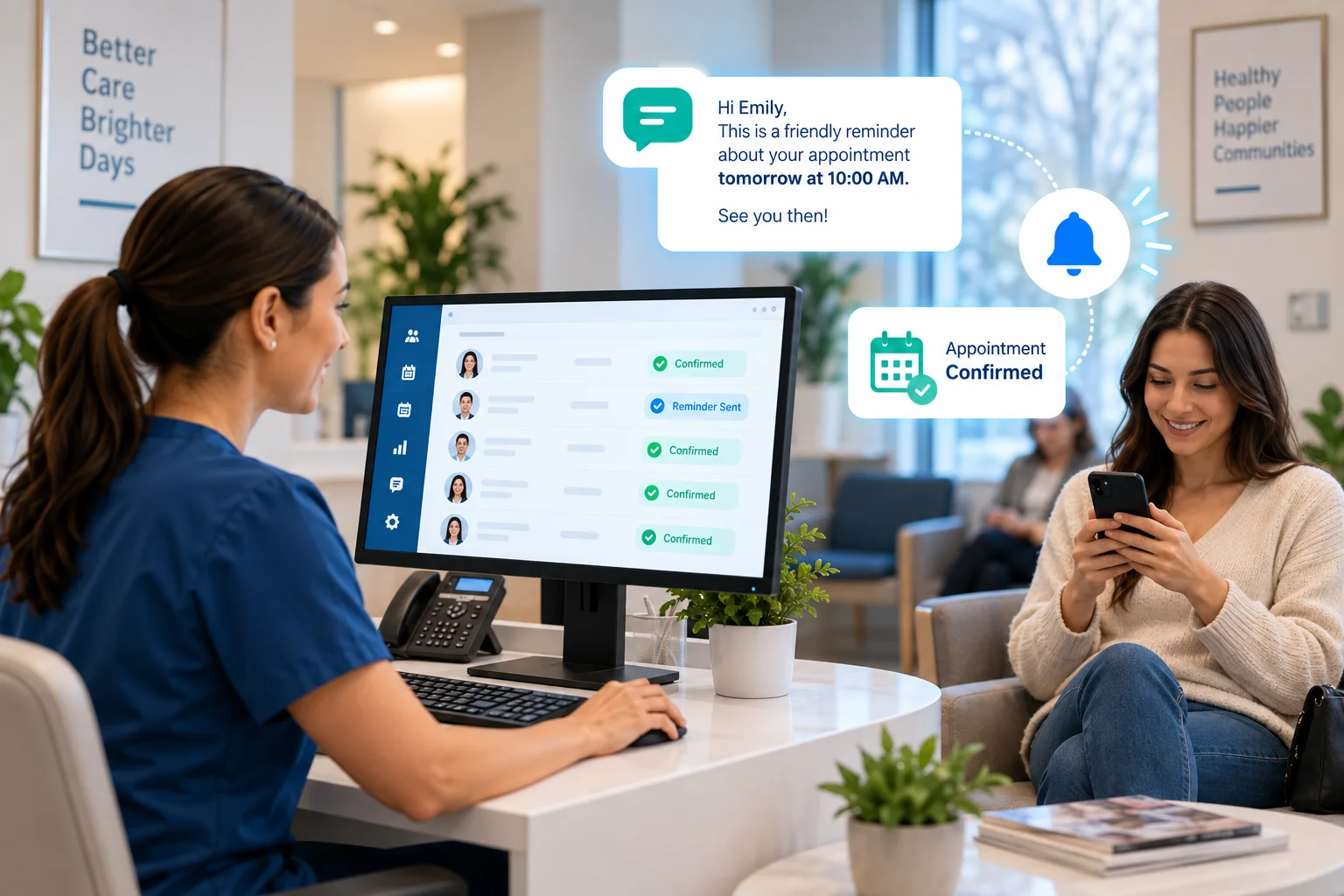
Reminders reduce no-shows by removing the two logistics causes outright: the client no longer forgets, and the client no longer needs to reach a person to make a change. Automation extends that to the hours when nobody is at the desk, which is when most cancellation decisions get made.
A cadence that works for counselling:
At booking. Immediate confirmation with the date, time, clinician, format (in person or virtual), and a reschedule link.
48 hours before. A reminder that restates the notice window and carries the same link. This is the message that recovers the slot early enough to refill it.
24 hours before. A short confirmation request. A reply or tap confirms attendance.
After a miss. A same-day, non-judgmental message with open times attached.
Behind that, three pieces of front-office automation carry the load. Missed-call text-back answers the client who called the office and got voicemail, turning a dead call into a text thread. Automated booking lets that thread end in a filled slot without staff involvement. A waitlist fills cancellations that come in with enough notice.
HiClinic's counselling practice automation handles this layer specifically, including the AI receptionist that answers after-hours calls, missed-call text-back, and automated recall for clients who have drifted out of their session rhythm. It works alongside your existing practice management software, including Jane App, and stays entirely in the front office. No charting, no clinical records, no billing.
Setup runs about seven days, staff training takes roughly 30 minutes, and most practices see their first recovered appointment inside 48 hours. Billing is month to month with no long-term contract.
The admin side of this compound. Practices that automate intake paperwork and reminders together tend to find the same staff hours are freed twice over, a pattern covered in how counselling practices cut intake admin time.
When should a counselling practice charge a late cancellation fee?
A counselling practice should charge a late cancellation fee only when a documented pattern persists after the client has been given an easy reschedule path and a direct conversation. Charging before those two conditions are met penalizes a client for a gap in your systems.
Situations where a fee is defensible:
- The client has missed three or more sessions with no notice, after reminders were confirmed as delivered.
- The reschedule link and after-hours cancellation option were available and unused.
- The clinician has raised the pattern in session and agreed an expectation with the client.
- The written policy, including exceptions for illness and crisis, was provided at intake.
Situations where it is not:
- A first miss.
- A client who tried to reach the practice and could not.
- A cancellation tied to a mental health crisis, a safety concern, or an acute symptom flare.
- A client on a sliding scale or in financial hardship, where the fee may end care entirely.
What should a practice track to know the policy is working?
A practice should track the no-show rate alongside three supporting numbers, because the rate alone hides whether the improvement came from clients attending or from clients leaving.
- No-show rate by clinician and by time slot. Early-morning and last-slot appointments usually carry different rates, and the fix is scheduling rather than policy.
- Reschedule rate. A rising reschedule rate against a falling no-show rate is the signal you want. It means clients are using the exit path.
- Unanswered call volume. Every unanswered call during business hours is a possible reschedule that becomes a no-show.
- Attrition after a missed session. If clients disappear after their first miss, the follow-up message is doing the wrong job.
Drop-off patterns in one vertical often repeat in another. The same mid-course disengagement that shows up in physiotherapy patients who stop attending after the third visit appears in counselling around the point where sessions move into harder material.
Key takeaways
- A cancellation fee recovers revenue from a no-show. It does not prevent one.
- Most counselling no-shows are reachability and memory problems, not motivation problems.
- Give every client a one-tap reschedule path that works at 11pm without a phone call.
- Keep the first miss free of charge and follow it the same day with open times.
- Treat a repeat pattern as clinical material first and a policy matter second.
- Keep reminder content minimal and consent-based under PIPEDA, provincial health privacy law, and CASL.
- Measure reschedule rate and unanswered calls, not just the no-show rate.
Ready to hold your schedule without penalizing your clients? See how HiClinic supports counselling practices.