 Danish Wadhwa
 Dr. Varun Bajaj, MD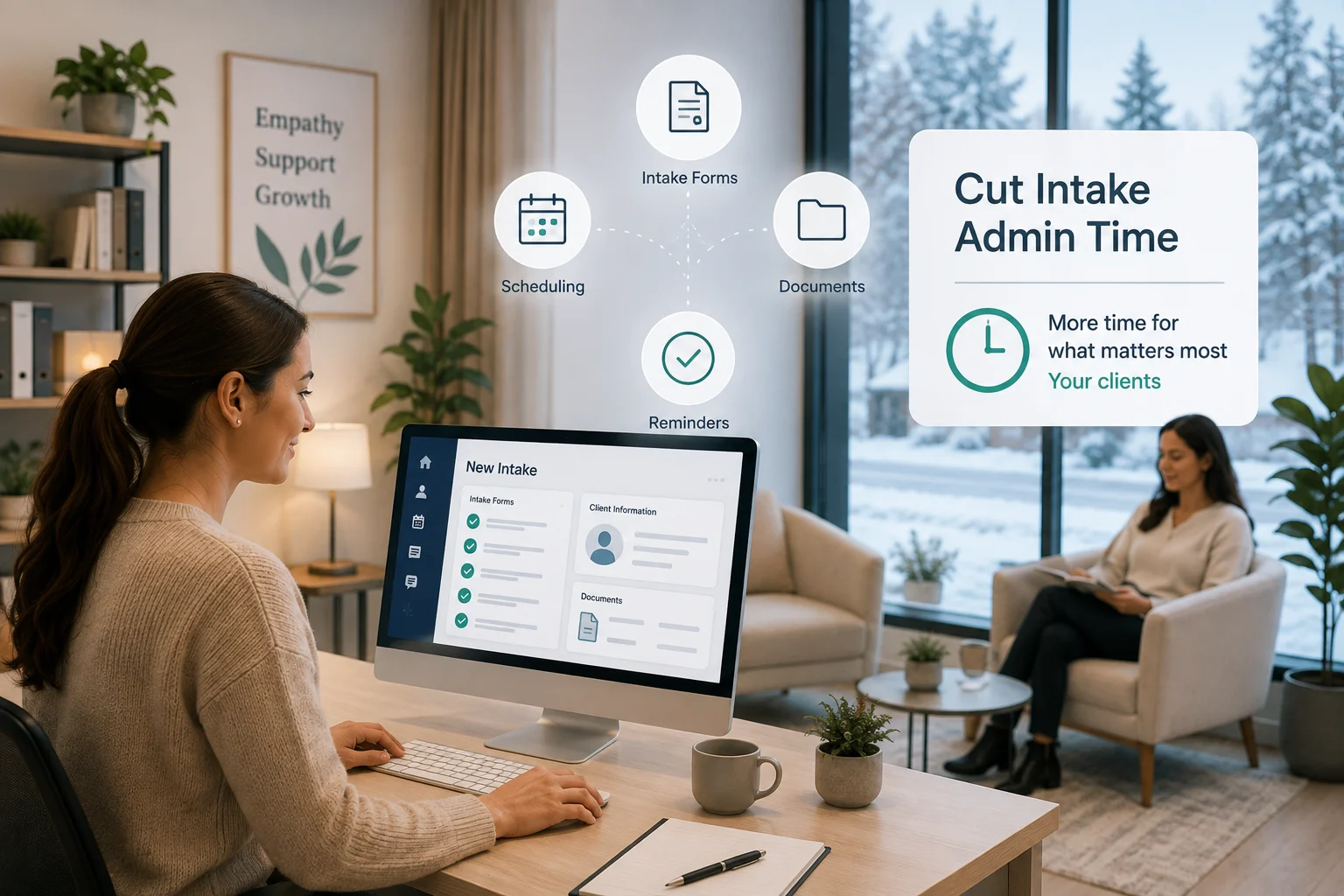
TL;DR — Key Facts
- Solo counsellors spend an estimated 15–20 hours per week on administrative tasks unrelated to direct patient care.
- Intake admin alone — forms, scheduling, follow-ups, and communication — accounts for up to 40% of a counsellor's non-clinical time.
- Fragmented communication tools (separate email, phone, and SMS inboxes) are the single biggest driver of intake delays.
- Centralising patient communication into one workflow can cut intake processing time by more than half.
- Faster, smoother admin directly lifts patient satisfaction — the clearest signal of a healthy practice.
How Much Admin Does a Solo Counsellor Actually Carry?
A solo counsellor typically manages 15–20 hours of administrative work every week — on top of clinical hours. That breaks down as roughly two hours of admin for every one hour spent with a patient.
Intake admin is the heaviest load. Before a single session takes place, a counsellor has already:
- Received and replied to an initial enquiry (often across multiple channels)
- Sent, chased, and processed an intake questionnaire
- Verified insurance or confirmed payment details
- Scheduled the appointment and sent a confirmation
- Collected signed consent forms
- Answered pre-appointment questions
Each step is low-complexity in isolation. Together, they compound into a significant operational burden, one that grows with every new patient and shrinks the time available for clinical work.
What Intake Tasks Eat the Most Time in a Counselling Practice?
The five intake tasks that consume the most counsellor time are patient communication, form collection, scheduling, cancellation handling, and follow-up.
Patient communication is the top offender. Enquiries arrive by email, phone, SMS, and online form — often with no single place to view them all. Counsellors manually check multiple inboxes, risk missing messages, and repeat context with every platform switch.
Form collection runs a close second. Sending intake questionnaires, waiting for responses, and chasing incomplete submissions is a slow loop — especially when forms are sent by email and tracked manually.
Scheduling adds another layer. Confirming appointment times, handling rescheduling requests, and syncing calendars across systems creates a steady drip of back-and-forth that interrupts clinical focus. When that back-and-forth stalls, it feeds directly into patient no-show rates — because disorganised scheduling leads to missed confirmations.
Cancellation handling generates its own paperwork trail. Each cancellation triggers a rescheduling conversation, a possible waitlist review, and a note in the patient record. Without a structured process, cancellations pile up into a reactive scramble rather than a managed workflow.
Follow-up closes the loop — but only if the counsellor remembers to do it. Manual follow-up on incomplete intake forms, unconfirmed appointments, or outstanding payments relies entirely on memory and discipline, two things that thin out during a heavy caseload.
Why Does Admin Overload Hurt Patient Outcomes?
Admin overload hurts patient outcomes because it delays intake, fragments communication, and reduces the mental bandwidth counsellors bring to clinical work.
When a new patient submits an enquiry and waits days for a response — because the message is buried in an email thread — that delay creates friction at the most sensitive moment of the patient journey. Patients exploring counselling support are often in a vulnerable decision-making window. A slow or disorganised intake process increases drop-off before the first session even happens.
Inside the practice, admin overload crowds out clinical preparation. A counsellor who spends 45 minutes before a session chasing a missing consent form arrives at that session less prepared than one whose intake workflow ran itself.
The downstream effect shows up in patient satisfaction scores. Patients rate their experience from the first point of contact — not just from the therapy room. An intake process that feels disjointed signals a disorganised practice, regardless of the quality of care delivered.
How Can Counselling Practices Reduce Intake Admin Time?
Counselling practices reduce intake admin time by standardising their intake workflow, automating repetitive steps, and consolidating patient communication into a single system.
Standardise first. Before automating anything, map every step between an initial enquiry and a confirmed first appointment. Most practices discover steps that are redundant, inconsistent, or dependent on a single person's memory. Removing those steps is faster than automating them.
Automate form delivery and reminders. Intake questionnaires, consent forms, and pre-session instructions should be triggered automatically at the point of scheduling — not sent manually after. A form that arrives the moment an appointment is booked gets completed faster and requires fewer follow-up chasers.
Consolidate communication. The largest single time saving comes from pulling all patient messages into one place. When email, SMS, and phone enquiries live in separate tools, counsellors spend time switching contexts and reconstructing conversation history. A unified inbox eliminates that overhead entirely.
Build a cancellation protocol. Every cancellation should trigger a defined sequence: an automatic acknowledgement, a rescheduling prompt, and a waitlist check if applicable. Practices that handle cancellations reactively spend three to five times more admin time on them than practices with a fixed protocol. A structured approach to handling patient cancellations pays back in reduced admin hours within weeks.
What Does a Streamlined Intake Workflow Look Like?
A streamlined counselling intake workflow moves a new patient from first enquiry to confirmed appointment in under 48 hours, with minimal manual intervention from the counsellor.
The steps look like this in a well-optimised practice:
- Enquiry received — all channels feed into one inbox; no channel-switching required
- Auto-acknowledgement sent — patient receives confirmation within minutes, not hours
- Intake form triggered — questionnaire link goes out automatically with the acknowledgement
- Appointment offered — scheduling link allows the patient to self-book within available slots
- Consent form sent on booking — triggered at the point of confirmation, not chased separately
- Reminder sent 24–48 hours before the session — automated, personalised, and consistent
- Session proceeds — counsellor arrives with a complete intake file, no outstanding admin
The difference between this workflow and the average solo practice is not technology, it is structure. The counsellor who builds this sequence once runs it indefinitely without manual effort at each step.
How Does a Unified Inbox Change the Way Counsellors Work?
A unified inbox reduces counselling practice admin by routing all patient messages — email, SMS, phone notes, and form responses — into a single, searchable conversation thread per patient.
Without a unified inbox, a counsellor responding to a patient email has no visibility of the SMS that patient sent yesterday, or the voicemail they left last week. Every interaction is context-free. The counsellor either reconstructs context manually (time-consuming) or responds without it (error-prone).
With a unified inbox, every patient's communication history is in one place. The counsellor sees the full thread, responds once, and moves on. Intake chasing — the single largest drain on admin time — becomes a managed queue rather than a mental to-do list.
HiClinic's unified inbox is built specifically for healthcare practices managing high-volume patient communication. It consolidates incoming messages, surfaces outstanding intake steps, and allows counsellors to process a full intake without leaving a single screen.
Key Takeaways
- A solo counsellor carries 15–20 hours of admin per week; intake tasks represent the largest share of that time.
- The five biggest intake time sinks are communication, form collection, scheduling, cancellation handling, and follow-up.
- Admin overload delays patient intake, increases drop-off, and reduces clinical preparation time.
- Standardising the intake workflow before automating it removes redundancy at the source.
- A unified inbox is the highest-leverage single change a counselling practice can make to reduce intake admin.
- Faster, cleaner intake directly improves patient satisfaction and reduces no-show rates — making admin efficiency a clinical outcome, not just an operational one.
Ready to see what a unified inbox does for your intake workflow? Explore HiClinic's tools for counselling practices.