 Danish Wadhwa
 Dr. Varun Bajaj, MD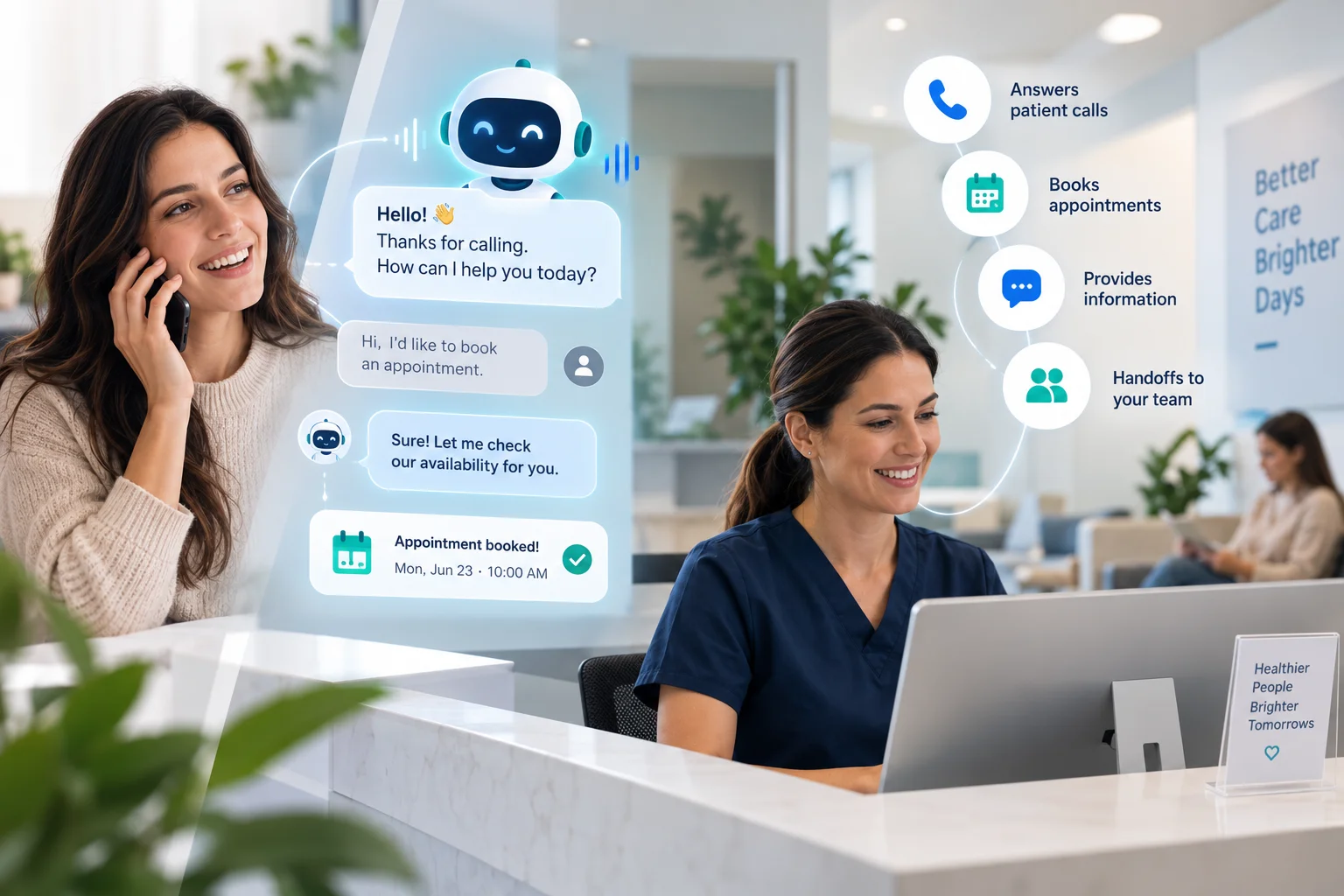
It is 8:30 on Monday morning. Your receptionist is checking in a patient, another person needs help with a form, and the phone starts ringing. Someone calling to book their first appointment reaches voicemail.
Your team has not done anything wrong. There are simply more conversations than they can manage at once.
For clinics, these moments affect more than phone queues. They influence whether patients book, whether questions get answered, and how much unfinished work follows staff through the day.
AI patient communication offers another way to manage that pressure. Voice agents can handle routine conversations, collect information, and support appointment bookings while staff help patients who need personal attention.
The opportunity starts with making your clinic easier to reach and giving every inquiry a clear next step.
What Is AI Patient Communication?
AI patient communication uses conversational software to respond to patient inquiries through channels such as phone calls, website chat, and text messages.
A voice agent handles the spoken part of that experience. It interprets what a caller says, responds using information approved by the clinic, and follows configured workflows.
Depending on its capabilities and integrations, it can:
- Answer questions about opening hours, locations, and services.
- Capture contact details and appointment requests.
- Book or reschedule eligible appointments.
- Send confirmations or follow-up messages.
- Transfer conversations that require staff involvement.
The difference between an AI receptionist and a chatbot matters when choosing a solution. A website chatbot typically handles typed conversations. A voice-enabled receptionist also supports people who prefer to call.
Clinics may need both, connected to the same communication workflow.
Why Patients Need More Ways to Reach Your Clinic
Patients fit healthcare into working days, school runs, and family responsibilities. Calling during office hours is not always convenient. Neither is waiting for a callback to ask a straightforward question.
A 2022 Phreesia survey of 4,136 US patients found that 84% would probably or definitely book appointments online, while 82% would reschedule online. These findings describe preferences for digital scheduling, rather than results from voice AI, but they show demand for easier appointment management.
Phone access still matters. Reporting from the same survey listed phone calls at 65% and text messages at 55% among patients' preferred ways to communicate with their doctor's office. The options were not mutually exclusive.
For Canadian clinics, these US findings provide useful context, rather than a local benchmark. The practical lesson is to offer connected choices: a conversation by phone, a convenient text, or an online booking option.
How an AI Voice Agent Handles a Patient Call
Consider a patient calling a physiotherapy clinic after work to ask about an initial assessment.
A properly configured voice agent could handle the conversation in five steps:
- Introduce itself: Explain that the caller is speaking with the clinic's automated assistant.
- Understand the request: Identify whether the patient wants information, an appointment, or help from staff.
- Use approved information: Explain the clinic's assessment options and booking requirements.
- Take the next action: Offer eligible appointments through a connected calendar or capture a request.
- Confirm the outcome: Repeat the details and explain what happens next.
The distinction between booking and requesting matters. If the system cannot confirm an appointment, it should clearly say that staff will follow up.
A useful conversation ends with clarity. Patients should know whether they are booked, awaiting a callback, or being transferred.
Five Ways Voice Agents Can Improve Patient Communication
1. Give Routine Questions a Faster Answer
Opening hours, parking instructions, service availability, and appointment preparation are simple questions that still interrupt busy staff.
Voice agents can answer from a maintained knowledge base, allowing patients to get information without waiting for someone to finish another task.
Accuracy depends on the information provided. Holiday closures, changed fees, and updated services need to be reflected in the system.
For example, a dental patient asking whether the clinic opens on Saturday should receive the current schedule, not an answer based on last year's hours.
2. Capture Inquiries Outside Office Hours
A patient may remember to call only after the clinic has closed. Without another response option, the next step depends on whether they leave a message and remain available for a callback.
Voice agents can provide after-hours information and capture booking interest while the patient is ready to act.
Understanding how much missed calls cost clinics starts with separating general inquiries from genuine booking opportunities. Not every unanswered call represents lost revenue, but unanswered appointment requests deserve attention.
Capturing the caller's details and intended next step makes follow-up more focused.
3. Reduce Booking Back-and-Forth
Appointment coordination becomes frustrating when every change requires another call.
With suitable calendar access, voice agents can check availability and apply rules for appointment length, provider schedules, and visit types.
That configuration is essential. A new-patient consultation may require a different slot from a routine follow-up.
When scheduling information is unavailable or a request falls outside the rules, the system should send it to staff. This avoids giving patients a confident answer that the clinic cannot honour.
The goal is fewer unnecessary exchanges while keeping control of the schedule.
4. Make Intake More Organised
New inquiries often arrive with incomplete information. Staff then spend time collecting details before they can help.
Voice agents can gather basic administrative information consistently, such as contact details, preferred appointment times, and the service requested.
For teams working to reduce intake admin time in counselling practices, a structured first contact can make the next conversation easier.
Keep the collection proportionate. An initial booking inquiry should not become an unnecessary request for sensitive personal history.
Clinical assessment and decisions about appropriate care should remain with qualified professionals.
5. Keep Conversations Connected
A patient might ask about a service through website chat, call the following day, and then reply to a text.
When those interactions sit in separate systems, staff must piece together what happened. Patients may be asked to repeat information they have already provided.
A connected communication workflow gives the team access to the relevant history and outstanding action.
Voice agents are more useful when their work remains visible after the call ends. Someone should be able to identify what the patient requested, what was confirmed, and whether follow-up is still needed.
Where Human Involvement Remains Essential
A natural-sounding conversation does not establish clinical reliability.
A 2024 systematic review published in the Journal of Medical Internet Research examined 65 papers on conversational large language models in healthcare. Fifty-eight papers — 89% — raised concerns about reliability, bias, or both. The review covered broader healthcare applications, not just telephone reception systems.
For clinic owners, the implication is practical: define what the assistant can do and where its authority ends.
Medical questions, distressed callers, uncertain answers, and requests outside approved workflows need a clear route to people. Urgent situations require a clinic-approved escalation process.
Patients should also be able to request human help without repeatedly negotiating with the system.
What to Check Before Introducing Voice AI
Start with one recurring communication problem, such as missed after-hours inquiries or repetitive scheduling calls.
Then assess the workflow around it:
- Information: Are services, hours, fees, and booking instructions current?
- Integration: Can the system complete the required calendar action?
- Handoffs: Who receives unresolved requests, and when?
- Patient experience: Can callers correct details or ask for staff?
- Data handling: What is collected, stored, retained, and accessible?
Ask vendors to demonstrate your actual scenarios, including unclear speech, unavailable appointments, and failed transfers.
For Canadian clinics, include the person responsible for privacy in the review. Request documentation rather than relying on broad assurances.
Measure Completed Outcomes, Not Just Answered Calls
An answered call is only the beginning. The more useful question is whether the patient achieved an appropriate next step.
Track booking completion, unresolved requests, successful transfers, staff follow-up time, and patient feedback.
Compare similar periods before and after launch, accounting for changes in call volume, staffing, and marketing.
This also connects communication to patient acquisition. Effective healthcare SEO helps people discover your clinic; responsive communication helps them act on that interest.
Measure the complete journey from inquiry to confirmed appointment.
How HiClinic Supports Better Patient Communication
HiClinic was built around problems its founders understood firsthand. Dr. Varun Bajaj brought experience managing busy clinical environments. Danish Wadhwa brought experience building growth and automation systems.
Their shared focus was reducing the communication gaps that leave patients waiting and teams overloaded.
HiClinic AI receptionist supports routine calls, patient questions, and bookings. Its wider platform brings together missed-call recovery, follow-up automation, and a unified inbox so staff can manage conversations with better context.
Start with the communication problem your team encounters most often. Test the experience, review the outcomes, and expand from there.
Book a Free Demo to see how HiClinic can support your clinic's patient communication and reduce front-desk workload.