TL;DR / Key facts
- Value-based care pays clinics for outcomes and continuity, not visit volume — and both depend on reaching patients between appointments.
- A patient communication hub is the layer that answers every call, text, DM and web chat, then books, reminds, recalls and follows up automatically.
- Missed calls, not missed appointments, are the biggest revenue and continuity leak in most clinics: a voicemail is a care gap that never gets logged.
- Clinics that automate reminders typically cut no-show rates by 30 to 50 percent within the first 90 days.
- Individual patient phone calls cost practices roughly $15 to $20 each in staff time.
- The hub only earns its keep if it writes back to the EMR — otherwise it creates a second, conflicting record of the patient relationship.
Value-based care asks clinics to do something their front desk was never built for: stay in contact with patients who are not currently standing in the waiting room. Quality scores, care-gap closure and continuity metrics are all measured in the weeks between visits. That is exactly the window where a ringing phone goes to voicemail, a recall list sits untouched in a spreadsheet, and a patient who meant to rebook simply doesn't.
The traditional fix was a healthcare contact centre, a staffed room that absorbed overflow calls. The newer fix is a patient communication hub: a single automated layer that sits on top of the clinic's existing booking system and handles every channel a patient actually uses. This article covers what that layer does, why it maps so cleanly onto value-based incentives, and how to tell whether yours is actually moving outcome metrics.
What is a patient communication hub?
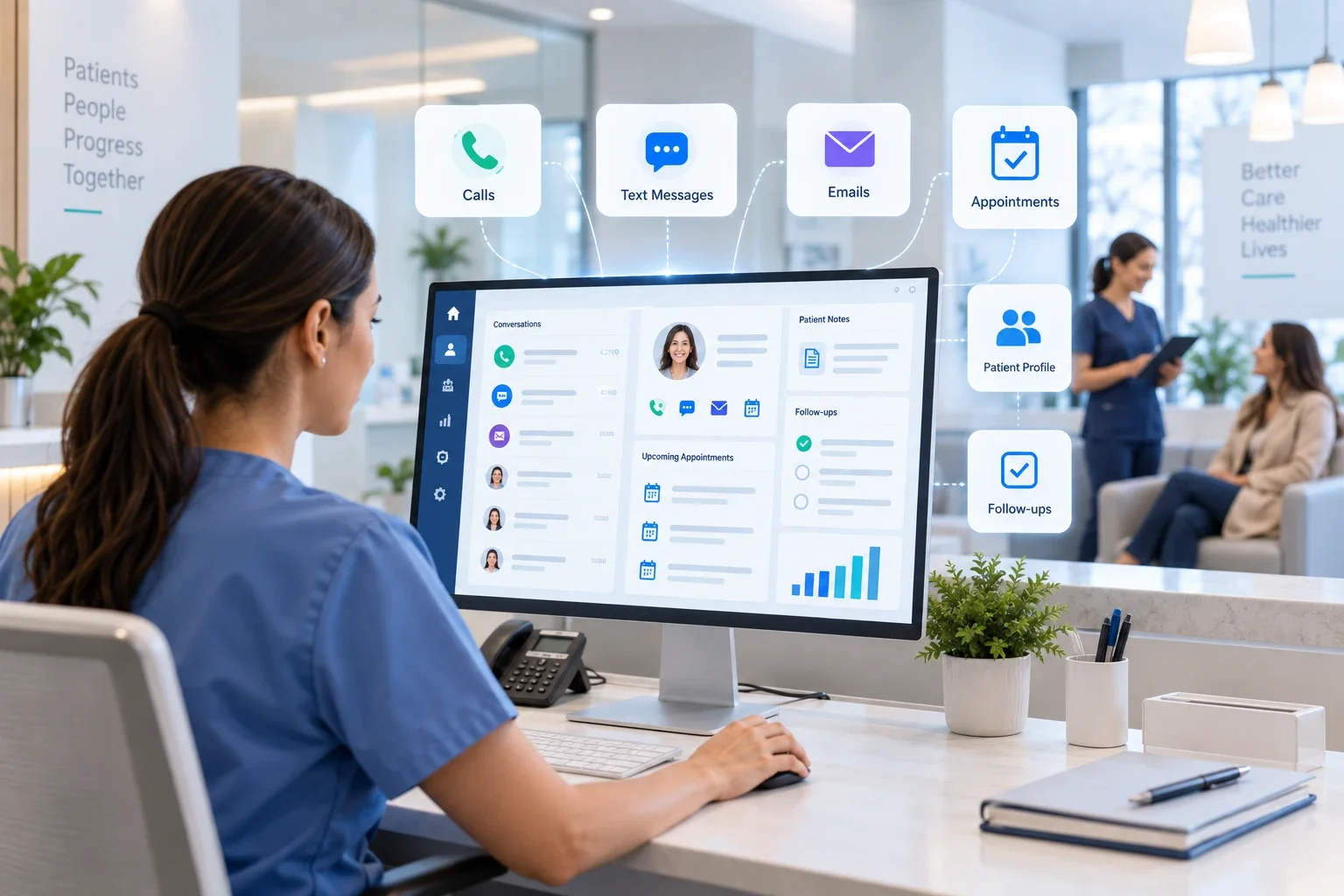
A patient communication hub is a single system that receives, routes and answers patient contact across phone, SMS, WhatsApp, web chat, email and social DMs, then acts on it by booking, rescheduling, reminding or escalating — without a staff member touching each message.
It differs from the two things clinics usually already have:
| Medium | Call centre | Contact centre | Patient communication hub |
|---|---|---|---|
| Channels | Phone only | Phone, email, chat | Every channel plus social DMs and missed-call text-back |
| Staffing model | Human agents | Human agents | Automated first response, humans on exceptions |
| Hours | Business hours | Extended | 24/7 |
| Booking | Transfers to clinic | Transfers or manual entry | Writes directly into the clinic calendar |
| Record of contact | Call log | Ticket | Unified patient thread, synced to the EMR |
The practical difference is that a hub closes the loop itself. A contact centre answers a question about a follow-up appointment; a hub answers it, offers the two open slots that match the practitioner and service duration, books one, and sends the confirmation — at 9pm on a Sunday.
Why does value-based care depend on communication infrastructure?
Because every value-based metric a clinic is measured on is a between-visit metric, and between-visit contact is almost entirely a communication problem rather than a clinical one. A missed follow-up, an unclosed care gap and an abandoned treatment plan all look identical in the data: the patient stopped showing up. None of them are caused by the quality of care delivered in the room.
Under fee-for-service, an unanswered call costs one visit. Under value-based arrangements, the same unanswered call compounds:
- Continuity scores fall when patients lapse out of a panel and re-enter care somewhere else.
- Care-gap closure stalls when the recall message for a screening or review never goes out.
- Avoidable utilization rises when a patient who couldn't reach the clinic goes to urgent care instead.
- Patient experience scores drop — access and responsiveness are what patients actually rate, more than clinical outcomes they can't assess.
The cost side is just as blunt. Routine patient calls run roughly $15 to $20 each in staff time, which means a clinic handling a few dozen refill and rebooking calls a day is spending five figures a year on conversations that contain no clinical decision at all. That budget is better spent on the outreach that actually moves outcome metrics.
How does a communication hub close care gaps?
A communication hub closes care gaps by turning the recall list into an automated, two-way outbound campaign that books appointments rather than just sending notices. The clinic defines a segment of patients overdue for a review, a screening, a third visit in a treatment plan — and the system messages them, answers the questions they reply with, and writes the booking into the calendar.
The sequence looks like this in practice:
- Segment first, not everyone. Start with one high-value cohort, such as patients who dropped off after their third visit, rather than blasting the whole database.
- Send on the channel they answer. Text gets read; voicemail does not. Most clinics see bookings within 48 hours of the first recall batch.
- Handle the reply automatically. "What's it for?" and "Can I do Thursday?" are the two most common responses and neither needs a human.
- Book into real availability. The hub reads the live calendar so it never offers a slot the practitioner can't take.
- Log everything back. The contact, the outcome and the booking sync to the patient record, so the gap is documented as closed.
HiClinic's team has documented this end to end for rehabilitation practices; the automated physio recall setup guide walks through a seven-day implementation including consent handling and segment selection. The same loop runs outside primary care too: veterinary practices use it for vaccination recalls and naturopathy clinics for treatment-plan follow-through, because the structural problem — long gaps between visits, no one to chase them — is identical.
How much of the no-show problem can automation actually solve?
Most of it. Clinics that automate appointment reminders typically cut no-show rates by 30 to 50 percent within the first 90 days, and the gains come from confirmation and easy rescheduling rather than from the reminder itself.
The mechanism matters more than the message. A one-way reminder tells a patient they have an appointment. A two-way reminder lets them cancel at 7am, which releases the slot in time for the hub to offer it to someone on the waitlist. The clinic converts a no-show into a filled appointment instead of an empty hour — and under a value-based contract, that filled hour is also a care encounter that counts.
Three configuration choices do most of the work:
- Two-way messaging, so a patient can reply "reschedule" instead of ignoring the text.
- Automatic backfill, so cancellations are offered to other patients without staff intervention.
- Missed-call text-back, so an unanswered ring becomes a conversation within seconds rather than a lost patient.
The selection criteria — including consent and sender-identification obligations for clinics — are laid out in this guide to appointment reminder software for clinics. Consent and identification requirements apply from the first message, so they belong in the build, not the cleanup.
Which capabilities separate a real hub from a chatbot?
The dividing line is whether the system can complete a transaction in the clinic's own systems. A chatbot answers; a hub acts. Use this as the evaluation checklist:
| Capability | Why it matters for value-based care |
|---|---|
| Live EMR and calendar integration | Bookings and outcomes land in the patient record, so quality reporting reflects reality |
| Omnichannel single thread | Staff see one conversation per patient, not six inboxes |
| Missed-call recovery | Recovers the contact that would otherwise become a care gap |
| Outbound recall campaigns | Converts panel management from a spreadsheet into a running process |
| Escalation rules | Clinical or urgent messages route to a human immediately |
| Reporting on contacts and bookings | Lets you attribute metric movement to the outreach that caused it |
The integration requirement is the one clinics most often underestimate. A hub that can't write to the EMR creates a parallel record of who was contacted and what was agreed, and within a quarter the two versions disagree. Platforms such as HiClinic's AI receptionist are built to sit on top of Jane, Juvonno, Practice Better, Cliniko and similar systems rather than replace them, which keeps clinical documentation and billing exactly where the team already works.
Where should a clinic start?
Start with the leak you can measure this month, not with a full transformation programme. Three sequenced moves get a clinic most of the value:
- Instrument inbound contact. Count missed calls, after-hours calls and average response time for a week. Most clinics are surprised by the after-hours number.
- Automate the reminder and missed-call loop. This is the fastest measurable win and it requires no change to clinical workflow.
- Add one outbound recall segment. Pick the cohort with the clearest care gap, run it for 30 days, and compare booked appointments against the previous period.
Only then is it worth expanding to full omnichannel coverage. Sequencing this way also gives you a clean before-and-after for each change, which is what you need when a payer or health authority asks what drove the improvement in your continuity numbers.
Key takeaways
- Value-based care is won and lost between appointments, and between-appointment contact is an infrastructure problem.
- A patient communication hub differs from a contact centre by completing bookings and recalls itself, across every channel, around the clock.
- Automated reminders with two-way replies and backfill cut no-shows by 30 to 50 percent in the first 90 days.
- Recall campaigns turn care-gap closure from a manual list into a running, logged process.
- EMR write-back is non-negotiable — without it, the hub's record and the clinic's record diverge.
- Start narrow: instrument inbound contact, automate reminders, then add one recall segment.
Next step: map one quarter of missed calls and lapsed patients against your quality metrics. The overlap is usually the business case.