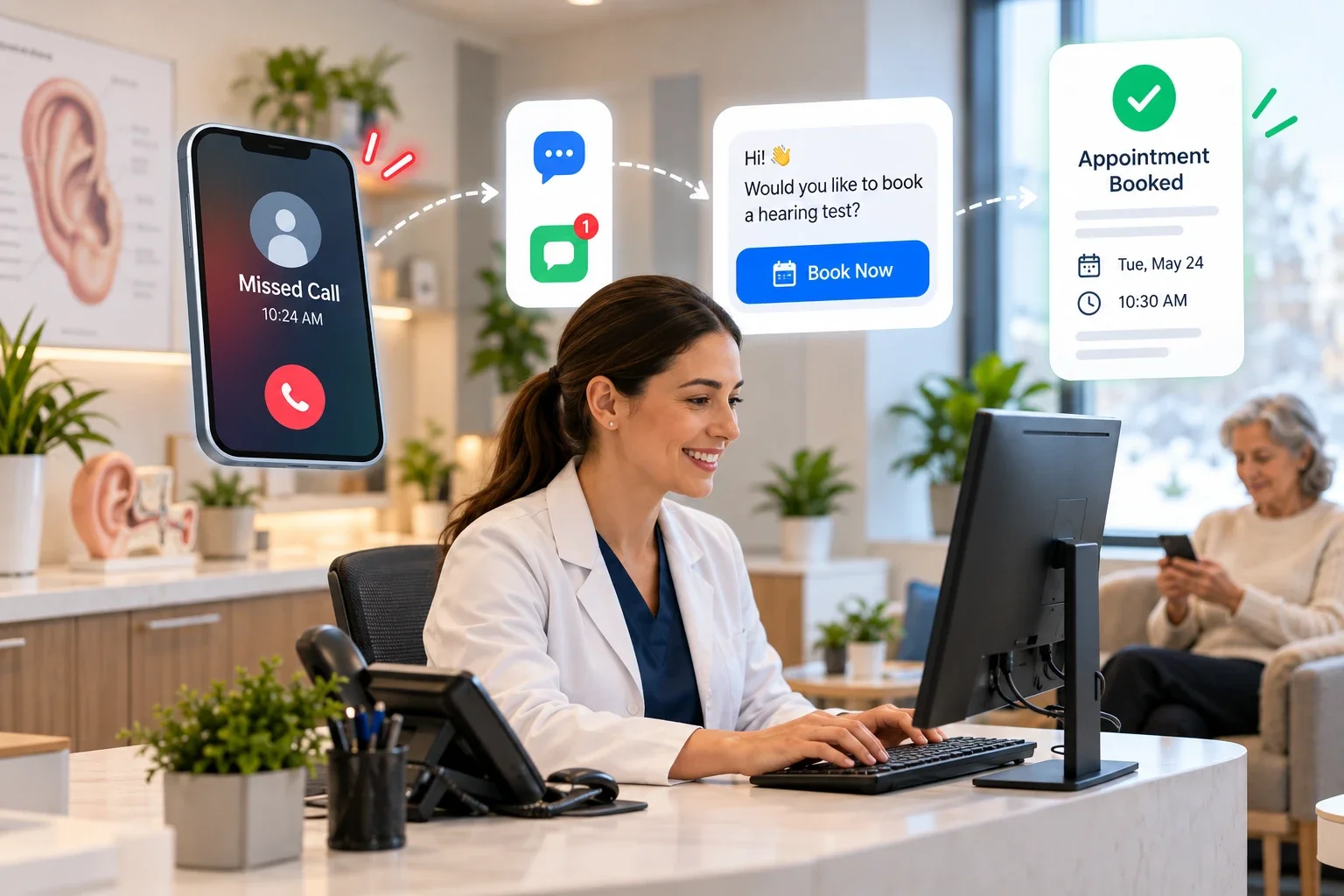
Audiology clinics can help patients book hearing tests after missed calls by offering written follow-ups, clear online scheduling, and assistance through the patient's preferred communication channel. Tracking each inquiry through to a confirmed appointment helps front-desk teams reduce phone tag and keep unfinished conversations from being forgotten.
Key facts
- 22% of US adults ages 65–74 have disabling hearing loss, rising to 55% among adults aged 75 and older, according to NIDCD estimates based on hearing examination data from 2015–2020. Booking options should account for patients who find telephone conversations difficult.
- A missed incoming call and an unanswered callback need different responses. Both should give the patient a clear way to continue without repeatedly dialing.
- Text follow-ups and online booking give patients written scheduling options, while staff assistance remains available for those who need it.
- A booking request should be clearly distinguished from a confirmed appointment. Follow-ups should stop once the patient books, declines, or opts out.
HiClinic connects AI call answering, patient messaging, booking, and follow-up in one clinic growth platform, helping teams coordinate the steps between an initial inquiry and an appointment.
Why hearing test booking needs more than phone calls
A patient calls your audiology clinic during lunch. Your receptionist is helping someone check in, so the call goes unanswered. Later, your team calls back, but the patient is working and cannot pick up.
Two calls. No conversation. No appointment.
For hearing clinics, phone tag creates a particular challenge: some people trying to reach you may already find telephone conversations difficult. Repeated callbacks can add another barrier between an initial inquiry and a booked hearing test.
Other patients simply cannot answer during your opening hours. They may be working, traveling, or coordinating the appointment with a family member.
A booking process that supports different communication preferences gives patients more ways to take the next step. Some will want a telephone conversation. Others will prefer a message they can read and respond to when convenient.
The aim is to make both options easy.
Identify where the conversation stops
"Missed calls" can describe two separate problems:
- Your clinic misses an incoming call. The patient needs acknowledgment and a way to continue.
- The patient misses your callback. Your team needs an alternative to repeated dialing.
Treating both situations as "call again later" keeps the same bottleneck in place.
Start by reviewing your call records and open inquiries. Check whether unanswered calls cluster around lunch breaks, busy check-in periods, or evenings. Then look at how many callbacks lead to a conversation and how many inquiries remain unresolved.
The interruption between patient care and telephone work also appears in physiotherapy clinics dealing with missed calls. For audiology practices, communication preferences deserve particular attention when designing the follow-up.
Your goal is to understand which next step helps each patient move forward.
Send a useful written follow-up
A missed-call response should acknowledge the inquiry and offer something the patient can do immediately.
Where texting is appropriate and permitted, a simple message could read:
Hi, this is [Clinic Name]. Sorry we missed your call. You can request an appointment here: [link], or reply if you would prefer help from our team.
For a patient who previously requested a hearing test, a follow-up might say:
Hi [First Name], this is [Clinic Name] following up on your appointment request. Would you prefer to continue by text or arrange a callback?
Keep the first message brief. Avoid including symptoms, test results, or other sensitive details in an initial outreach message.
The useful change is the invitation to continue in writing. A patient who missed your callback can respond without finding another moment for a telephone conversation.
Build clear stopping rules into the workflow. Follow-ups should stop when the patient books, declines, opts out, or asks your team to take over.
Also check whether the patient has already contacted the clinic through another channel before sending another message.
Make online booking easy to complete
A booking link should reduce effort.
If patients must navigate your homepage, find the right service, and complete a long form, your follow-up has simply moved the friction to another channel.
Send them to a page that clearly explains:
- Which appointment they are requesting.
- Whether they are selecting a confirmed slot or submitting a request.
- Which clinic location they will visit.
- What information is needed to proceed.
- How to ask for scheduling assistance.
Appointment names matter. "New-patient hearing evaluation" is clearer than an internal abbreviation that only your staff understands.
Separate hearing evaluations from hearing aid adjustments, fittings, and other appointment types when they require different scheduling rules. If your clinic needs to review a referral or another requirement first, explain that before the patient submits the request.
For international practices, display dates unambiguously and show the relevant time zone. For US patients, give accurate information about insurance or referral requirements without implying that every plan covers the appointment.
A submitted request should never look like a confirmed booking unless the appointment has actually been reserved.
Ask patients how they prefer to communicate
A text-first option can help some patients, but it should remain a choice.
Ask a simple question early:
How would you prefer us to contact you: text, email, or phone?
Record the answer so another team member does not restart the process with an unwanted callback.
Allow patients to request staff assistance if the booking form is difficult to use. Where a caregiver helps coordinate appointments, establish who the clinic is authorized to communicate with before sharing patient information.
Written confirmations should use plain language, readable text, and clear instructions. Avoid placing essential appointment details only inside an image.
Accessible booking starts with listening to the patient's preference and carrying that preference through the rest of the workflow.
Use AI call answering to reduce the initial gap
Recovering an unanswered call helps. Answering the initial inquiry can remove a follow-up step altogether.
An AI receptionist can handle routine scheduling questions when staff are occupied or the clinic is closed. Patients may ask about opening hours, locations, hearing test availability, or how to arrange an appointment.
HiClinic's AI receptionist for audiology clinics supports call answering, appointment booking, reminders, and follow-ups. Its audiology page also describes capturing patient information and managing conversations through a unified inbox. Configure the receptionist around your clinic's approved information and appointment rules. Keep clinical questions and situations requiring judgment connected to your staff's established process.
Patients should also have an easy way to move from a voice conversation to written communication or human assistance. Automation works best when it helps the patient continue comfortably.
Track every inquiry through to a clear outcome
A callback list tells your team whom to contact. A patient inquiry pipeline tells them what needs to happen next.
Useful stages might include:
| Stage | Next action |
|---|---|
| New inquiry | Acknowledge the request |
| Awaiting patient response | Follow up through the preferred channel |
| Needs staff assistance | Assign a team member |
| Appointment requested | Check scheduling requirements |
| Booked | Send confirmation |
| Closed | Record the outcome and stop follow-ups |
Keep phone calls, messages, and scheduling activity connected to the same inquiry where possible. Before contacting a patient, your team should be able to see whether they already replied or booked.
Communication history, task ownership, and inquiry tracking are among the healthcare CRM features that support clinic growth. Together, they help the front desk manage unfinished conversations without relying on memory.
Assign an owner to inquiries that need human help. Automation should surface these tasks clearly rather than leave them sitting in an inbox.
Confirm the appointment in the patient's preferred channel
Once a hearing test is booked, make the confirmation easy to understand.
Include the date, time, location, and any clinic-approved preparation instructions. Give patients a straightforward way to request a change or ask for help.
A written confirmation allows the patient to revisit the details later. It also helps prevent uncertainty about whether an appointment request was accepted.
Choose reminder timing based on your clinic's workflow and patient preferences. Avoid sending overlapping reminders from several systems.
After the visit, the same organized communication process can support feedback. A consistent approach to automated clinic review requests can invite patients to share their experience without the front desk remembering each request individually.
Keep feedback requests neutral and separate from appointment access.
Measure completed bookings, not just messages sent
Sending more follow-ups does not necessarily mean your booking process has improved.
Track outcomes that show whether patients are progressing:
- Time from inquiry to first response.
- Percentage of missed inquiries that receive a reply.
- Percentage that become confirmed appointments.
- Attendance among patients booked through follow-up.
- Staff time spent resolving each inquiry.
Define your measures consistently. For example:
Missed-inquiry booking rate = confirmed appointments from missed inquiries ÷ unique eligible missed inquiries × 100.
As an illustration, if 20 of 80 eligible missed inquiries become confirmed hearing tests, the booking rate is 25%. This is a calculation example, not an industry benchmark.
Count unique inquiries rather than every repeated call. Otherwise, a patient who phones three times can distort your results.
Compare performance over several weeks and review unresolved inquiries alongside the numbers. That combination helps you spot whether the remaining barrier is scheduling availability, unclear instructions, or a communication channel that does not suit the patient.
Give patients a clear next step after every missed call
A missed call should leave the patient with an easy way to continue.
For audiology clinics, that means acknowledging the inquiry, offering written scheduling options, respecting communication preferences, and keeping the conversation visible until it reaches a clear outcome.
Start with the point where your patients currently get stuck. A useful text response, a clearer booking page, or better inquiry tracking can make the next step easier for both patients and your team.
Book a Free Demo to see how HiClinic can support your hearing test booking workflow.