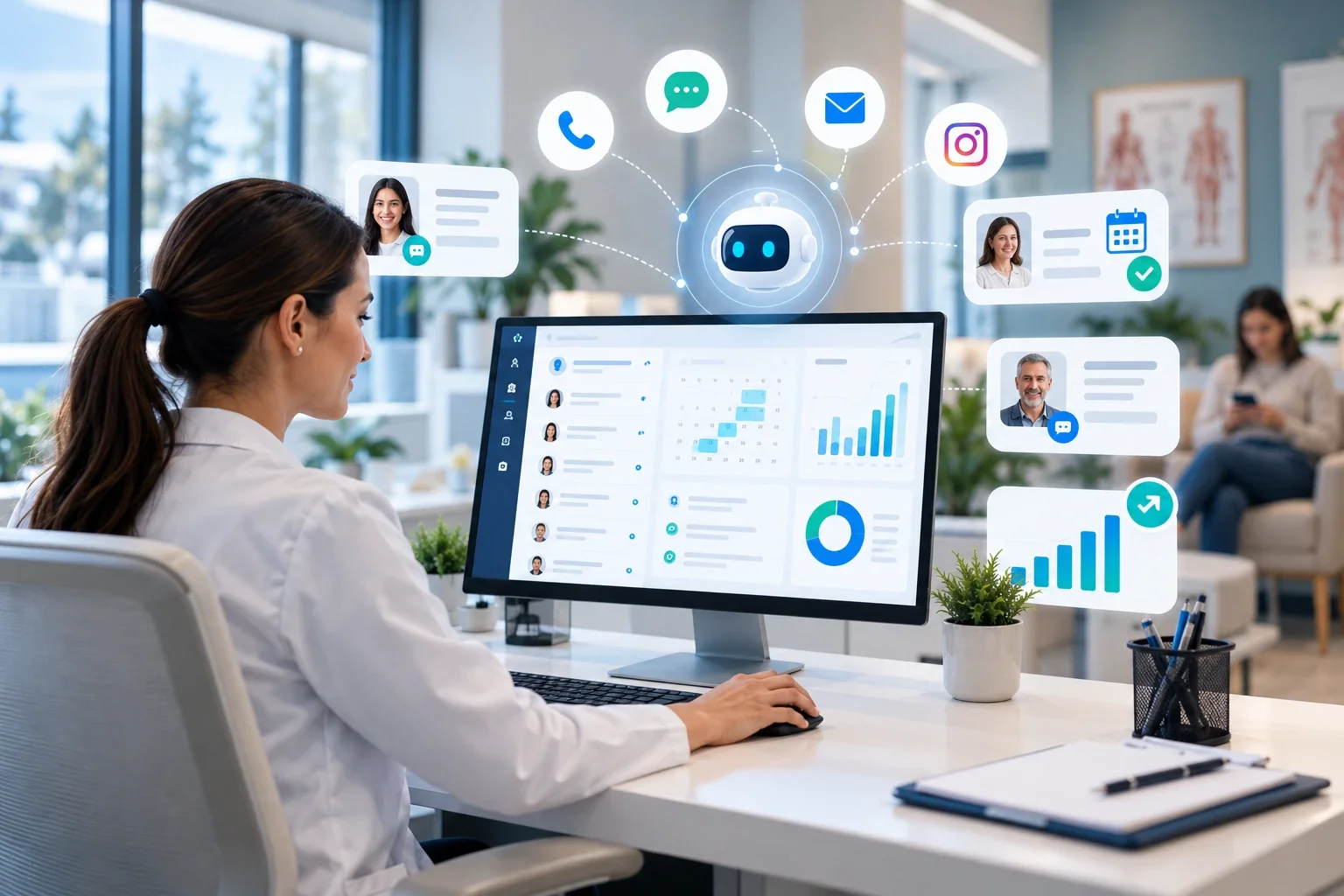
Five AI trends are reshaping healthcare marketing worldwide: AI answer engines, conversational patient acquisition, personalized communication, predictive retention, and privacy as a trust signal. Together they shift the goal from ranking on a search page to being the answer a patient acts on.
Key facts
- Grand View Research projects that the global AI-in-healthcare market will reach US$505.6 billion by 2033. This forecast covers healthcare AI broadly, not healthcare marketing spending alone.
- Patients increasingly research symptoms and providers through AI assistants, so visibility now means being cited in AI answers, not only ranking in search.
- Conversational AI captures inquiries around the clock, which recovers bookings that clinics lose to unanswered calls.
- Privacy regulation shapes every trend on this list, and rules differ by region: HIPAA in the United States, GDPR in the European Union, and PIPEDA in Canada.
HiClinic is a clinic front-office automation platform, and these trends map directly to how practices attract and keep patients.
What are the top AI trends in healthcare marketing?
The top AI trends in healthcare marketing are AI answer engines, conversational patient acquisition, personalized communication, predictive patient retention, and data privacy as a differentiator. Each one changes a different stage of the patient journey, from the first question a patient asks to the moment they rebook.
The five trends, in order of how early they touch the patient journey:
- AI answer engines change how patients discover clinics.
- Conversational AI converts inquiries into booked appointments.
- AI personalization tailors patient communication at scale.
- Predictive AI keeps patients engaged and reduces drop-off.
- Privacy and trust decide which brands patients share data with.
Specialty practices are adopting these tools across the board, from audiology clinics to orthodontic and naturopathic providers, because the patient acquisition problem looks the same in every vertical.
How are AI answer engines changing how patients find clinics?
AI answer engines can give patients information directly within a search experience. In a Pew Research Center analysis of browsing data from 900 U.S. adults in March 2025, users clicked a traditional search result on 8% of visits with an AI summary, compared with 15% without one. The study covered Google searches generally, not health-related searches specifically. For clinics, it highlights why visibility in AI answers deserves attention alongside website rankings.
This shifts the marketing goal from ranking to being cited. To earn a citation in ChatGPT, Perplexity, Gemini, or Google AI Overviews, a clinic's content has to be structured for extraction:
- Answer the question first. Lead each section with a direct, one-sentence answer an engine can lift.
- Use clear, factual statements. Short subject-verb-object sentences are easier for engines to quote than long, hedged prose.
- Keep facts consistent. Repeating the same accurate details across pages builds the consensus AI engines trust.
Clinics that structure content this way get named in the answer a patient reads, which is the new front page of healthcare search.
How is conversational AI turning inquiries into booked appointments?
Conversational AI can support appointment booking by responding to routine inquiries outside front-desk hours. Invoca's 2026 healthcare benchmark report found that 54% of inbound calls in its healthcare dataset were answered by a person. That does not mean the remaining 46% went to voicemail or lost bookings; the measure is human answer rate, not missed-call rate. Clinics should track unanswered calls and booking outcomes in their own data to identify where follow-up could help.
An AI front office closes that gap in three ways:
- It answers immediately. Missed calls trigger an automatic text back, so the conversation continues instead of ending at voicemail.
- It books without staff time. The system offers open slots and confirms the appointment by SMS and email.
- It works after hours. Inquiries that arrive at night or on weekends still convert into scheduled visits.
The question of whether software should own this work is worth thinking through. Our breakdown of an AI receptionist versus a human receptionist covers where each performs best. In practice, most clinics use AI to handle volume and routine booking while staff focus on patients in the room.
How does AI personalize patient communication at scale?
AI can help tailor patient communication by adapting messages to a patient's appointment type, visit history, and communication preferences. Instead of assuming a fixed engagement lift, clinics should compare replies, confirmations, and completed bookings across their own campaigns.
The mechanism is straightforward. AI groups patients by visit history, appointment type, and channel preference, then sends the right reminder, recall, or follow-up to each group automatically. A first-time patient gets an intake and directions message, while a returning patient gets a recall notice when they are due.
Personalization also raises how patients experience a clinic between visits, which supports the long-term relationships that drive retention and referrals.
How does predictive AI improve patient retention and recall?
Predictive AI improves patient retention by spotting patients who are likely to lapse or miss appointments, then prompting outreach before they drop off. Models flag risk from patterns such as time since last visit and past no-shows, and automated recall campaigns re-engage those patients without manual list-pulling.
Two outcomes make this a marketing trend, not only an operations one:
- Fewer empty slots. Predicting no-shows lets a clinic confirm or backfill at-risk appointments, protecting revenue that would otherwise be lost.
- More lifetime value. Timely recall brings patients back for follow-up care, which costs far less than acquiring a new patient.
Retention is where marketing budgets earn the most, since keeping an existing patient is consistently cheaper than winning a new one.
Why is data privacy becoming an AI marketing differentiator?
Data privacy matters in AI healthcare marketing because patient communication can involve sensitive personal information. Clinics should explain what data they collect, why they need it, and how it will be used. Clear information helps patients make informed choices about sharing their details.
Privacy rules differ by region, and global marketing has to account for all of them:
- United States: HIPAA governs protected health information.
- European Union: GDPR sets consent and data-handling standards.
- Canada: PIPEDA and provincial health-privacy laws apply.
The trend for marketers is to treat privacy as a visible feature rather than fine print. Clear consent, transparent data use, and tools that limit what data they hold all build the trust that turns interest into a booking. HiClinic processes front-office data such as contact and appointment details, and each clinic stays responsible for meeting its local obligations.
How can clinics adopt these AI marketing trends?
Clinics can adopt these trends by starting with the front office, where AI produces results fastest, and layering tools onto systems they already run. Front-office automation books appointments, answers missed calls, and sends reminders, so it touches acquisition and retention at the same time.
A practical rollout looks like this:
- Structure your website content so AI answer engines can cite it.
- Add conversational AI to capture and book inquiries around the clock.
- Automate personalized reminders and recall for existing patients.
- Connect the tools to your current stack so data stays in one place. HiClinic's integrations let it work alongside the scheduling software a clinic already uses.
Because these tools layer on rather than replace, a clinic can go live quickly. HiClinic sets up in about 7 days, trains staff in roughly 30 minutes, and most clinics see a first result within 48 hours.
Key takeaways
- Five AI trends are reshaping healthcare marketing: answer engines, conversational acquisition, personalization, predictive retention, and privacy as trust.
- Visibility now means being cited in AI answers, so content must be structured for extraction, not only for ranking.
- Conversational AI recovers inquiries lost to voicemail and books them without staff time.
- Predictive AI protects revenue by reducing no-shows and driving recall, where marketing budgets earn the most.
- Privacy regulation shapes every trend, and treating it as a visible feature wins patient trust across regions.
See how HiClinic automates the front office behind these trends. Book a walkthrough.