 Danish Wadhwa
 Dr. Varun Bajaj, MD
Dental clinics lose potential patients in the same short window every day: the phone rings, the front desk is checking someone in or helping another patient, and the caller hangs up and contacts the next clinic.
An AI dental receptionist is designed to close that gap.
Instead of sending unanswered calls straight to voicemail, an AI receptionist can answer calls, respond to common questions, check availability, and help patients book appointments — even when your front desk is busy or your clinic is closed.
This guide covers what an AI dental receptionist does, how it differs from an AI dental assistant, what implementation looks like, what it costs, and what to compare when choosing an AI receptionist for your dental practice in 2026.
Key Facts
- An AI dental receptionist can answer calls 24/7, respond to common patient questions, capture caller details, and book appointments.
- It is front-office software designed to work alongside your existing clinic systems rather than replace your clinical software.
- HiClinic provides white-glove setup, including custom greetings and scripts, calendar and EMR sync, live call testing, and a dedicated onboarding specialist.
- HiClinic's AI Receptionist currently costs $498 USD/month, plus $500 USD one-time onboarding.
- Missed-call recovery can help clinics capture patient inquiries that might otherwise end at voicemail.
What Is an AI Dental Receptionist?
An AI dental receptionist is software that uses conversational voice AI to answer calls and handle routine front-office conversations.
Depending on the platform and configuration, it can answer common patient questions, capture caller information, check appointment availability, book appointments, and route conversations requiring human attention. Unlike traditional voicemail, an AI receptionist can interact with the caller immediately.
You'll see several related terms when researching these systems:
- Dental virtual receptionist — a broader category that can include AI systems or remote human receptionists.
- AI receptionist for dentists — an AI-powered system designed to handle front-office patient calls and conversations.
- Dental receptionist software — software designed to support front-desk communication, booking, messaging, reminders, or related workflows.
- AI dental software — a much broader category that can include both administrative and clinical AI applications.
The important distinction is what the technology actually handles. If your goal is to answer more calls, handle routine questions, book appointments, and reduce repetitive front-desk work, you're looking for AI receptionist software for dental clinics.
Is an AI Dental Receptionist the Same as an AI Dental Assistant?
No.
An AI dental receptionist focuses on front-office communication. It can support workflows involving patient calls, appointment booking, common questions, and other routine interactions.
An AI dental assistant generally refers to technology supporting clinical workflows, such as radiograph analysis, clinical documentation, or chairside assistance.
They solve very different problems. If your dental practice struggles with missed calls, after-hours inquiries, appointment booking, or a front desk overwhelmed by repetitive phone conversations, you're looking for an AI receptionist for dentists. If your problem involves diagnostic or clinical workflows, you're evaluating a different category of dental AI software.
How Does an AI Receptionist Work in a Dental Office?
An AI receptionist connects with your clinic's communication and scheduling workflow and handles patient conversations according to rules configured for your practice.
A typical patient call might look like this:
- The AI answers the call. The patient hears a custom greeting configured for your dental practice.
- It understands what the patient needs. The caller might want to schedule an appointment, ask about opening hours, get directions, or ask a routine service question.
- It checks appointment availability. Where configured, the AI can access available appointment slots.
- It books the appointment. Confirmed appointments can be placed directly into the connected calendar without manual entry.
- It captures information when necessary. If the request can't be completed automatically, relevant details can be captured for your team.
- The conversation is documented. HiClinic provides full call transcripts that can be searched through the dashboard.
The objective isn't simply to answer the phone. It's to move the patient from inquiry to the appropriate next step without requiring your front desk to manually handle every routine interaction.
Why Do Dental Practices Use AI for Their Front Office?
Dental practices depend heavily on consistent patient communication.
Your team isn't only answering new-patient calls. They're also handling existing patients, scheduling questions, cancellations, appointment changes, directions, insurance-related questions, and other repetitive requests throughout the day. That creates several opportunities for inquiries to slip through.
Capture More New-Patient Inquiries
A potential patient may call while your receptionist is checking someone in, helping another caller, or away from the desk.
An AI receptionist gives the caller an immediate response instead of automatically sending the inquiry to voicemail. For dental practices concerned about this problem, HiClinic's guide to missed-call text back explains another way clinics can keep missed callers engaged.
Handle After-Hours Calls
Patients don't only search for dentists during office hours.
An AI receptionist can continue handling routine inquiries during evenings, weekends, holidays, or other periods when your front desk isn't available.
Book Appointments
Answering the phone doesn't accomplish much if the patient still has to wait for someone else to book the appointment.
Where properly connected and configured, an AI dental receptionist can check available times and help patients book during the conversation.
Reduce Repetitive Front-Desk Work
Your staff shouldn't need to manually answer the same questions dozens of times every week.
An AI receptionist can handle routine inquiries while your team concentrates on patients who are physically in the clinic and conversations that require human judgement.
Keep Patient Communication Organized
As clinics add calls, texts, and other communication channels, keeping track of conversations becomes increasingly difficult.
A unified inbox for medical practices can help centralize conversations instead of forcing staff to constantly switch between disconnected channels.
Does an AI Dental Receptionist Replace Your Front Desk?
No — and that shouldn't be the goal.
Dental receptionists handle situations requiring empathy, judgement, context, and coordination across the practice. AI is better suited to repetitive and predictable interactions.
Think of an AI receptionist as additional front-desk capacity. It can handle routine questions and calls when your employees are busy, while your staff remains available for situations where human involvement matters.
For a more detailed comparison, see AI receptionist vs human receptionist for clinics.
How Do You Implement an AI Receptionist in a Dental Office?
Implementation should start by teaching the system how your dental practice actually operates.
With HiClinic, the $500 USD one-time onboarding includes:
- Custom greetings and scripts. Responses are configured around your clinic's tone, services, and common patient questions. This helps the AI receptionist communicate in a way that fits your practice rather than relying on generic responses.
- Calendar and EMR sync. HiClinic connects with the scheduling and records systems your clinic already uses. The goal is to incorporate the AI receptionist into your existing workflow rather than force your practice to rebuild its operations around another standalone system.
- Live call testing. Real call flows are tested with your team before launch. Testing matters because an AI receptionist should understand how your practice wants different types of inquiries handled before patients begin interacting with it.
- Dedicated onboarding specialist. A dedicated specialist guides the setup process from beginning to launch.
HiClinic describes its onboarding as white-glove setup designed to get clinics live in days rather than weeks.
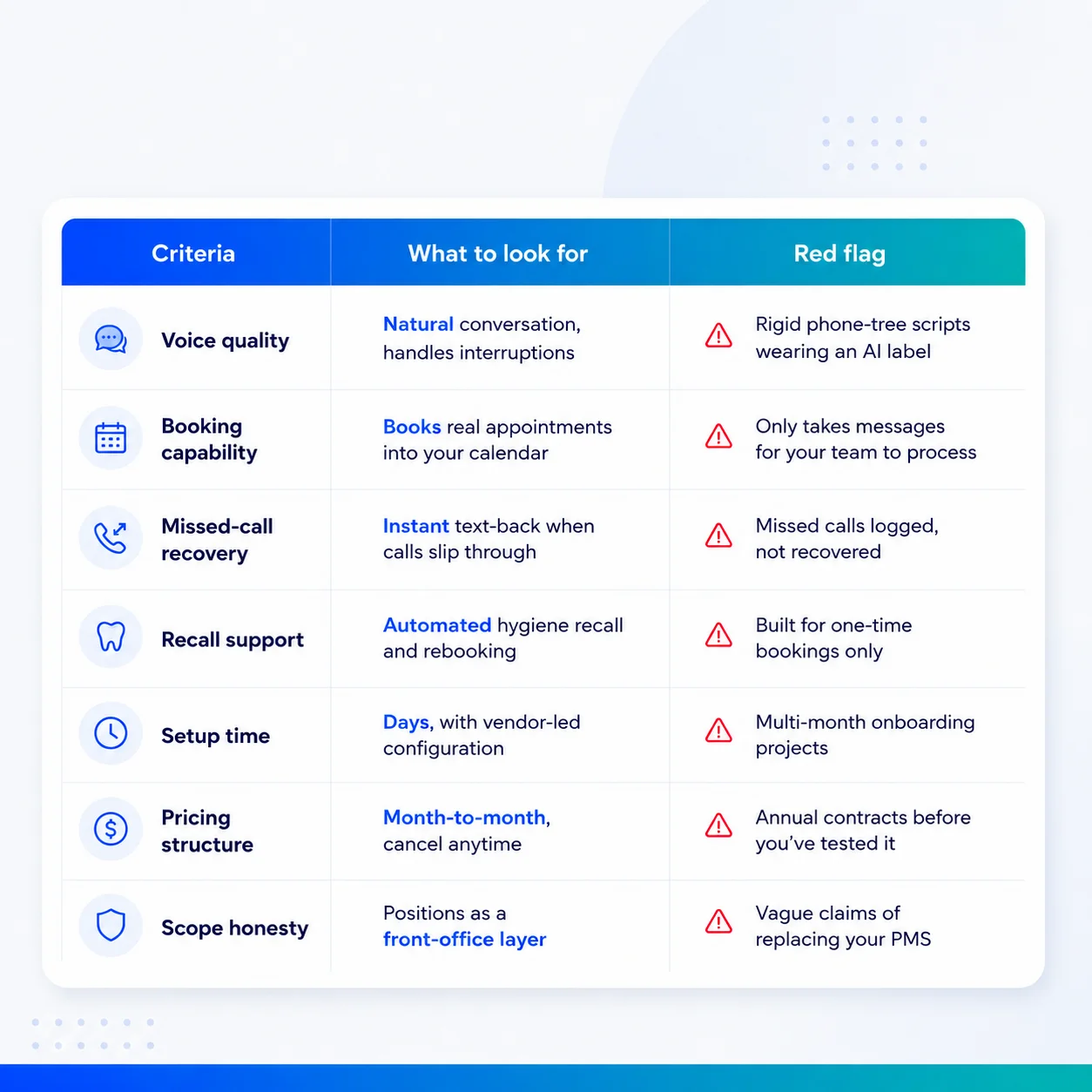
What Should an AI Dental Receptionist Be Able to Do?
Don't evaluate AI receptionist platforms based only on whether the voice sounds natural. A good voice is important, but the system also needs to accomplish useful tasks.
Which Are the Best AI Receptionist Solutions for Dental Clinics?
There isn't one "best" AI receptionist for every dental clinic.
A single-location general dental practice can have very different requirements from an orthodontic practice or a multi-location dental group. Instead of choosing based on the longest feature list, compare platforms against your actual workflows.
Ask each provider:
- Can the AI book appointments rather than just take messages?
- Can it check availability in real time?
- Can we customize how it answers questions?
- What happens when it doesn't know the answer?
- Can complex calls be escalated?
- Can we review call transcripts?
- How does it connect with our existing calendar or EMR?
- What happens when someone calls after hours?
- How quickly can we get the system live?
- Is onboarding included or charged separately?
- Is pricing based on calls, minutes, locations, or a flat subscription?
- Can we hear a live example before committing?
These questions reveal far more than simply comparing feature checklists.
How Much Does an AI Dental Receptionist Cost?
AI receptionist pricing varies considerably between providers. Depending on the vendor, pricing may be based on call minutes, usage, locations, features, or a monthly subscription.
HiClinic AI Receptionist pricing
HiClinic's current AI Receptionist pricing is $498 USD/month. The plan is designed for a single-location clinic and includes:
- 24/7 call answering
- Appointment booking
- Unified inbox for calls, texts, DMs, and reviews
- FAQ handling
- Full call transcripts
- White-glove setup with the clinic's existing tools
Onboarding: $500 USD one-time. The onboarding fee includes:
- Custom greeting and scripts
- Calendar and EMR sync
- Live call testing
- Dedicated onboarding specialist
Annual billing is also available, with the current pricing page showing $996 in savings compared with monthly billing.
When comparing providers, don't look at the monthly price alone. Compare what you're actually paying for. A cheaper service that simply takes messages isn't necessarily comparable to an AI receptionist that can answer questions, check availability, and book appointments.
How Do You Calculate Whether an AI Dental Receptionist Is Worth It?
Start with your own call data rather than relying on generic ROI claims.
Look at:
- How many calls does your practice miss each week? Your existing phone system may already provide this information.
- How many missed callers never speak with your team? A callback doesn't necessarily mean the patient answers.
- How many of those calls are new-patient inquiries? These are particularly important because the caller may be comparing several nearby dental practices.
- What is a new patient worth to your practice? Use your own numbers rather than a vendor's assumptions.
Then compare the value of additional appointments and administrative time saved against the software's monthly cost.
This gives you a much more useful answer than claims such as "one patient always pays for the software," because patient value varies considerably between dental practices.
AI Dental Receptionist vs Answering Service
Traditional answering services and AI receptionists can both provide coverage when your staff can't answer. But they work differently.
| AI Dental Receptionist | Traditional Answering Service |
|---|---|
| Uses conversational AI | Uses remote human agents |
| Can provide 24/7 coverage depending on provider | Coverage depends on service agreement |
| Can answer instantly | May involve queues or transfers |
| Can integrate with booking workflows | Often focuses on message taking |
| Consistent configured responses | Responses can vary between agents |
| Pricing may be subscription or usage based | Frequently billed by call or minute |
A human answering service can still be valuable when conversations consistently require human judgement. An AI receptionist is more attractive when a large percentage of calls involve predictable tasks such as appointment booking, opening hours, directions, and routine questions.
How to Choose an AI Receptionist for Your Dental Practice
Before choosing a platform, run a simple test. Give every vendor the same five realistic calls:
- "I'd like to book a new-patient appointment."
- "Do you have anything available tomorrow afternoon?"
- "I need to reschedule my appointment."
- Ask a routine question specific to your practice.
- Ask something the AI shouldn't answer independently.
Pay attention to what happens. Does it understand the caller naturally? Can it actually complete the booking? Does it recognize when human help is required? Does your staff receive enough context to continue the conversation?
That's a much stronger buying test than simply asking whether a platform "uses AI."
Key Takeaways
- An AI dental receptionist handles front-office patient communication; an AI dental assistant generally refers to clinical AI.
- It can answer calls, handle routine questions, capture patient information, and support appointment booking.
- The technology should complement your dental front desk rather than attempt to replace every human interaction.
- HiClinic's AI Receptionist currently costs $498 USD/month, with $500 USD one-time onboarding.
- HiClinic onboarding includes custom greetings and scripts, calendar and EMR sync, live call testing, and a dedicated specialist.
- Compare vendors based on what the AI can actually accomplish during a real patient conversation — not simply how natural its voice sounds.
- Use your clinic's missed-call volume, booking data, and patient value to determine potential ROI instead of relying on generic revenue promises.
See an AI Dental Receptionist in Action
Every call your team handles manually takes time. Every call that reaches voicemail creates another follow-up task and potentially another opportunity for the caller to move on.
An AI receptionist gives your dental practice another way to stay available without requiring someone at the front desk to answer every routine call.
See how HiClinic's AI receptionist for dental clinics handles patient calls, common questions, and appointment booking — or book a free call to hear it live.